
Crestview Criminal History Checks
Start locally and widen the search only as the question changes. A city police report explains what an officer documented; it does not prove the filed charge or final result. Crestview has no separate municipal judiciary, so city ordinance, misdemeanor, criminal-traffic, and felony case information moves into Okaloosa County's court system.
- Contact Crestview Police Records for a CPD incident, arrest, or crash report, using a case number, date, location, and involved names when known.
- Allow at least five business days after the incident before expecting a routine police report, while recognizing that an active investigation or protected information can delay or limit release.
- Search ClerkQuest or ask the Crestview Clerk counter for the filed court case and its disposition; there is no separate Crestview Municipal Court database.
- Use Okaloosa County Corrections for a county booking or present-custody record and the originating agency for its narrative.
- Use FDLE CCHInet or fingerprint-based personal review when the question requires reported Florida history rather than Crestview-only material.
Crestview's Five-Day Report Wait
CPD says incident reports normally need at least five business days after an event. That is a practical minimum, not a promise that every record will be ready on day five. Investigators may still be working, and Florida exemptions can protect active investigative material, victim information, juvenile details, or other confidential fields.
When timing matters, give Records the report number and ask whether a releasable version exists. If the office redacts a portion, the public-record rule generally calls for release of the remainder and identification of the exemption. Waiting for the city report does not prevent a separate check of the county booking locator or ClerkQuest, because those systems are maintained by different custodians.
Note: A missing city report and a missing court filing are different conditions; check each custodian before concluding that no record exists.
Records at the Crestview Police Department
Crestview Police Records works from the Whitehurst Municipal Building/Police Department at 201 Stillwell Boulevard. The counter is open weekdays from 8 a.m. to 5 p.m.; call 850-682-3544 or email recordsrequest@crestviewpd.org. Phone, email, and counter service are the primary documented routes because research found no dedicated CPD report-request web form.
The unit can locate a city-created record more efficiently when the requester supplies the incident date and time, location, case type, parties, and case number if available. CPD's records page also routes users to county warrants and inmate information, the FDLE registry, and the Florida Crash Portal. Those links are useful precisely because CPD does not own those other record layers.
The city's police public-information page shows the local department context.
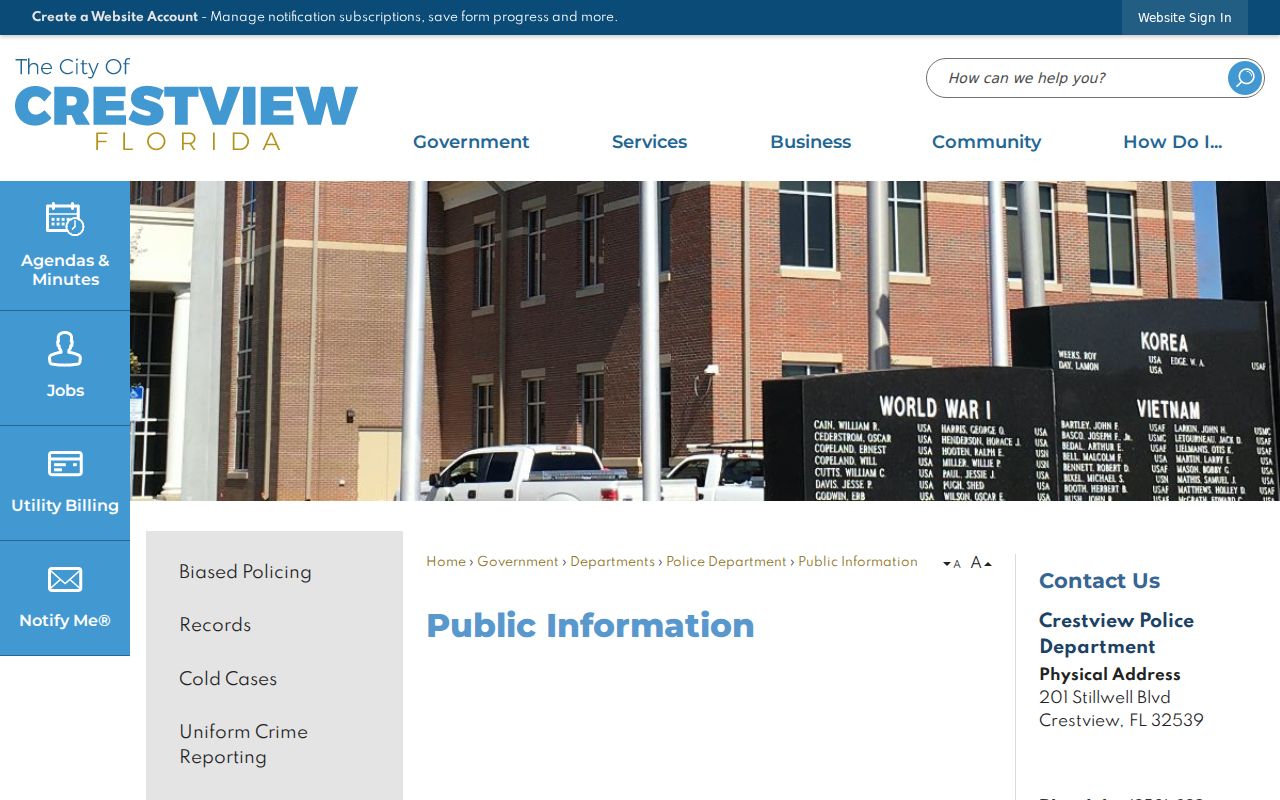
The department page helps identify CPD as the correct source for city police material, while county and state offices remain responsible for their own records.
Cash at the Crestview Records Counter
The Crestview counter accepts cash only, not checks or cards, and asks visitors to bring correct change. Published report-copy prices are 15 cents for a one-sided page and 20 cents for a double-sided page. A request demanding extensive clerical labor or information-technology research can carry a reasonable service charge under Florida law, so ask for an estimate before authorizing broad work.
The official CPD records instructions provide the source for these terms.
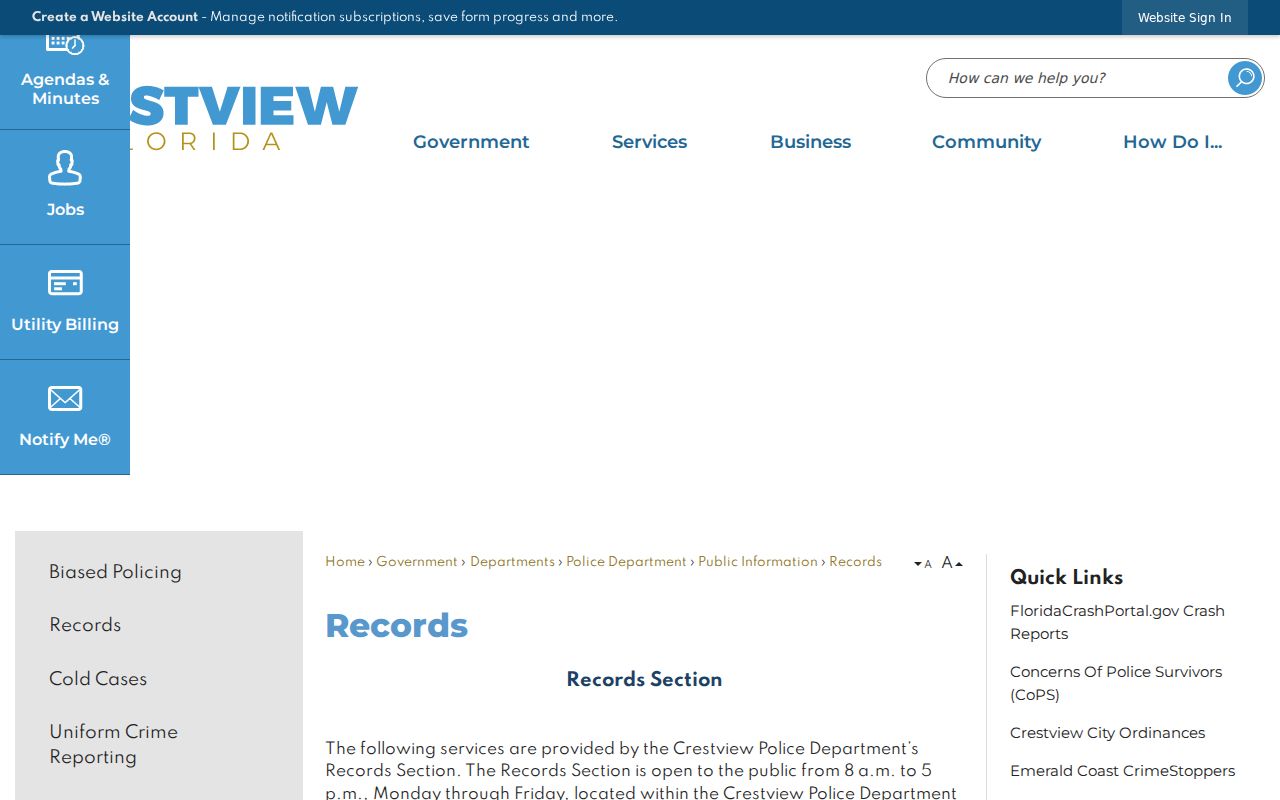
That fee structure favors a focused request. A narrow date range and known report number can reduce searching, but Florida does not require a requester to explain why a public record is wanted.
Booking and Arrest Records in Crestview
CPD creates its arrest report, but Crestview does not operate a separate city jail for the public booking layer described in the research. A person transported for county detention is booked by the Okaloosa Department of Corrections at 1200 East James Lee Boulevard. Corrections records the custody date, booking status, physical descriptors, bail or fine display, and available court information in its current locator.
That booking is an intake snapshot based on initial allegations. It is not a finding of guilt, and the displayed charge may differ from what the State Attorney files. If the locator has no expected result, call Corrections at 850-689-5690; a release, transfer, spelling difference, delayed update, or another custodian may explain the absence. For the incident narrative, return to CPD or whichever agency made the arrest.
Hub City Records Cross Jurisdictions
Crestview sits near U.S. 90, State Road 85, and Interstate 10, a setting behind its long-standing “Hub City” identity. Those corridors also explain why a Crestview event might originate with CPD, OCSO, Florida Highway Patrol, an airport or college agency, or another state or federal unit. A geographic location inside Crestview does not automatically make CPD the record custodian.
Look at the agency name on a citation, receipt, report number, or ClerkQuest party-and-charge display. Request the narrative from that originating agency. CPD itself warns that simple crime rankings can mislead because reporting practices, enforcement, and community conditions vary; research found no recent official city numeric table suitable for a current ranking.
The Crestview Municipal Court File
Crestview has no separate municipal-court judiciary. Ordinance matters and criminal traffic route through Okaloosa County Court; felonies proceed in Circuit Court. Search ClerkQuest, or use the Clerk counter at 101 East James Lee Boulevard, open weekdays from 8:30 a.m. to 4:30 p.m. and reachable at 850-689-5000.
| Court Name | Okaloosa County Court for misdemeanors, ordinance cases, and criminal traffic; First Judicial Circuit Court for felonies |
|---|---|
| Case Types Heard | Municipal ordinance matters, misdemeanors, criminal traffic, and felony cases at the appropriate county level |
| Case Lookup Channel | ClerkQuest, a Clerk public-record request, or the Crestview courthouse counter |
| What the Docket Shows | Case number, filing date, parties, charges, pleas, docket events, document status, disposition, and sentence where public |
| Copies & Fees | $1 per page, $2 per year searched, and $2 per document certification under the researched Clerk schedule |
Some entries are public online while others are marked View on Request; confidential, sealed, or non-public documents are not equivalent to nonexistent documents.
Crestview's County-Seat Advantage
Crestview incorporated in 1916 and became Okaloosa's permanent county seat after a 1917 election. That history gives local residents direct counter access to the north courthouse, in addition to CPD and the county jail. It also means three nearby buildings answer three different questions: Whitehurst holds city police material, Corrections holds booking and custody information, and the Clerk holds the prosecution file.
Use the Clerk counter when an online docket is capped, an older file is not digitized, or a document says View on Request. Ask CPD for the underlying city incident narrative. Ask Corrections about custody. This division prevents the common mistake of treating a courthouse search as though it also retrieves every police report.
How Crestview Records Reach the County
After a Crestview arrest, CPD supplies the originating report and arrest data. Corrections creates a booking if the person enters the county jail. The State Attorney decides whether and what to file, the Clerk opens the court case, and later disposition reporting can update the Florida repository. Delays and mismatches are possible at each handoff.
Record flow: Crestview Police Department › Okaloosa County Courts › Florida Department of Law Enforcement
For very recent activity, begin with CPD and Corrections. For formal charges and results, use the Okaloosa County court case lookup. For a statewide self-review, use FDLE's name-based CCHInet product or its fingerprint process, remembering that only fingerprints establish positive identity.
The FDLE criminal-history FAQ explains the state repository layer.
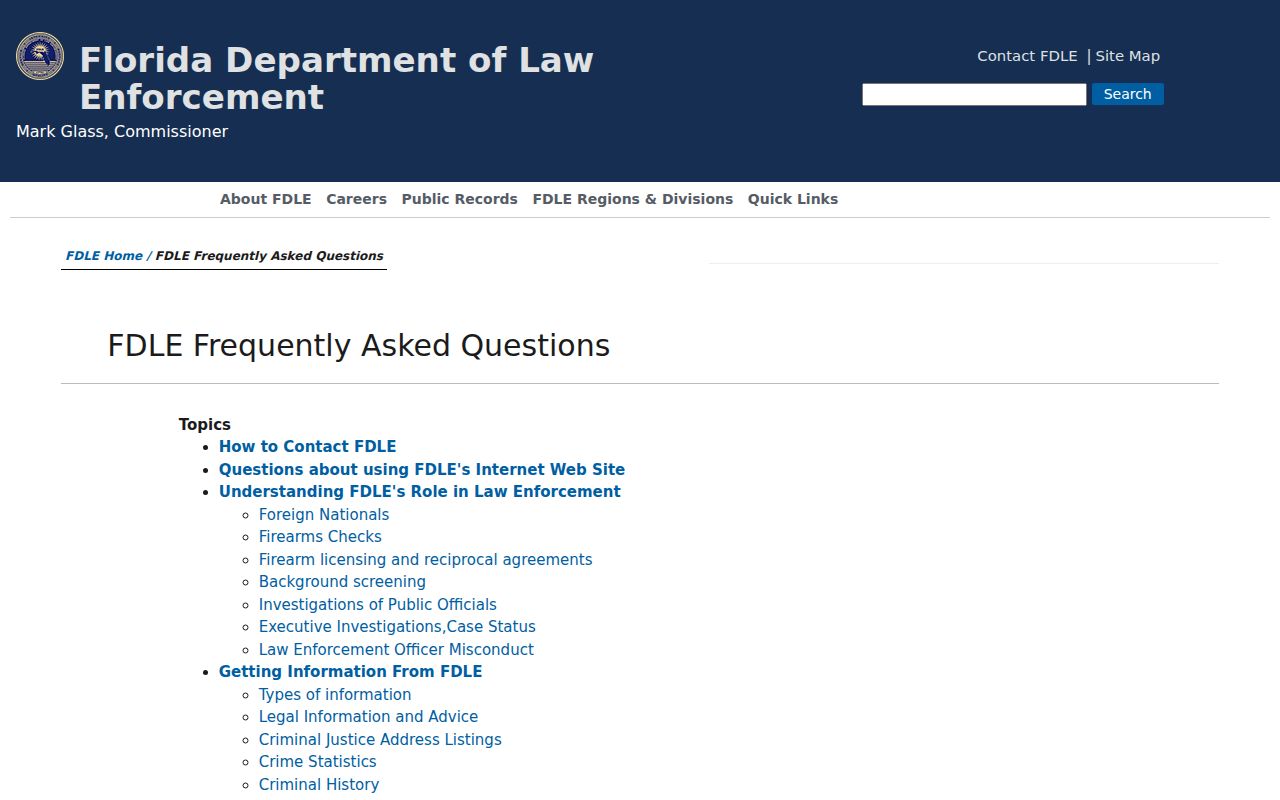
The state guidance reinforces why a Florida repository result cannot replace the local incident narrative or complete Clerk case file.
Crestview Crash Reports Take Another Route
CPD handles records for crashes it investigated, while its records page also points to the Florida Crash Portal. The correct route depends on the investigating agency and whether the statewide system has received the report. Supply the crash date, location, involved names, and report number when available.
A crash record can contain protected information during a statutory access period, and a crash citation may generate a separate county-court docket. Do not assume the traffic case and the crash narrative are the same record. If a citation becomes a criminal-traffic matter, ClerkQuest provides the filed-case layer after the Clerk opens it.
When Crestview Redacts an Open Case
A partially blacked-out report does not necessarily mean the whole incident is secret. CPD may protect active investigative details, victim or juvenile information, personal identifiers, or another field covered by a Florida exemption while releasing the rest. Ask which exemption supports each withholding and whether a supplemental report may become available after the investigative status changes.
Keep the version and request date. A later production may differ as the case progresses, but the police narrative will still describe investigation rather than the prosecutor's final choice. Compare it with ClerkQuest for charges, plea, dismissal, adjudication, and sentence. If a qualifying sealing or expunction order later changes public access, follow the official agency process instead of assuming every display updates at once.
Crestview Record Access Rules
Florida's constitutional and statutory access rules cover city records, subject to exemptions. A custodian must permit inspection or copying at reasonable times, respond in good faith, redact protected portions rather than withhold an entire record when feasible, and identify the legal basis for an exemption. Active investigations, juvenile information, victim details, sealed or expunged files, and sensitive personal data can limit access.
Key Statutes:
Florida Statutes §119.07 - requires reasonable public inspection and copying, permits statutory fees, and directs custodians to cite exemptions.
Florida Statutes §943.053 - governs FDLE dissemination of criminal-history information.
Florida Statutes §943.0585 - controls qualifying court-ordered expunction and resulting access limits.
A public result still needs source checking. Compare the city report, county docket, and final disposition before drawing conclusions from an arrest allegation.
Choosing the Crestview Source
Before submitting a Crestview request, state the artifact rather than asking broadly for a criminal record. For an officers account, request the CPD incident or arrest report. For jail intake and custody, contact Okaloosa Corrections. For a charge filed by prosecutors, a plea, disposition, sentence, or certified court copy, use the Clerk. For reported Florida history, use FDLE. This vocabulary helps staff route the request and prevents a narrow response from being mistaken for a complete history.
Dates also change the best starting point. Immediately after an incident, the police agency and Corrections may have information before a Clerk case exists. After filing, ClerkQuest can identify the formal charge and next event. After disposition, the docket supplies the outcome and FDLE may later associate it with the arrest cycle. Older files or documents marked View on Request may require the Crestview courthouse counter even when a basic docket appears online.
Keep a request log with the office, date, identifier, scope, fee, and response. If names or dates conflict, ask the office responsible for that field to review it. CPD cannot alter the Clerk docket, the Clerk cannot rewrite a CPD narrative, and Corrections cannot decide the final charge. FDLE has its own review-and-challenge channel for a persons state history.
A negative response is limited too. It may reflect spelling, date limits, another arresting agency, a record not yet filed, or material restricted by law. Describe it as no matching public result from the named source on the search date, not proof that no justice-system contact ever occurred.